
Our Work
.
Shared Path: A Journey Between Written and Visual Communicators
access the companion guide here
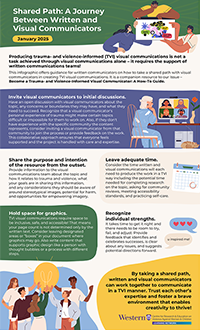
Producing trauma- and violence-informed (TVI) visual communications is not a task achieved through visual communications alone – it requires the support of written communications teams!
This infographic offers guidance for written communicators on how to take a shared path with visual communicators in creating TVI visual communications. It is a companion resource to our Issue – Become a Trauma- and Violence-Informed Visual Communicator: A How-To Guide.
Invite visual communicators to initial discussions.
Have an open discussion with visual communicators about the topic, any concerns or boundaries they may have, and what they need to succeed. Recognize that a visual communicator's personal experience of trauma might make certain topics difficult or impossible for them to work on. Also, if they don't have experience with the specific community the content represents, consider inviting a visual communicator from that community to join the process or provide feedback on the work. This collaborative approach ensures that everyone feels supported and the project is handled with care and expertise.
Share the purpose and intention of the resource from the outset.
Provide information to the visual communications team about the topic and how it relates to trauma and violence, what your goals are in sharing this information, and any considerations they should be aware of around stereotypical images, potential for harm, and opportunities for empowering imagery.
Leave adequate time.
Consider the time written and visual communications will each need to produce the work in a TVI way including the potential time needed for completing research on the topic, asking for community reviews, meeting accessibility standards, and practicing self-care.
Hold space for graphics.
TVI visual communications require space to be inclusive, safe, and accessible! That means your page count is not determined only by the written text. Consider leaving designated areas or “boxes” in your document where graphics may go. Also write content that supports graphic design like a person with thought bubbles or a process with different steps.
Recognize individual strengths.
It takes time to get it right and there needs to be room to try, fail, and adjust. Provide feedback that identifies and celebrates successes, is clear about any issues, and suggests potential directions forward.
By taking a shared path, written and visual communicators can work together to communicate in a TVI manner. Trust each other’s expertise and foster a brave environment that enables creativity to thrive!
All our resources are open-access and can be shared (e.g., linked, downloaded and sent) or cited with credit. If you would like to adapt and/or edit, translate, or embed/upload our content on your website/training materials (e.g., Webinar video), please email us at gbvln@uwo.ca so that we can work together to do so.