Our Work
.
We Won’t End Gender-Based Violence Without Disability Justice
-
English
-
Français
 Disability Justice is a movement and a framework that calls us to reimagine access, care, safety, and liberation. It centers the leadership and wisdom of those most impacted and offers principles that can transform how we understand — and respond to — violence. The 10 Principles of Disability Justice, developed by Sins Invalid, offer a path towards transforming how we understand and respond to GBV. Moving from theory to practice means reshaping the foundations of how support is offered, who is centered, and what we mean by safety.
Based on and adapted from the LN Brief We Won’t End Gender-Based Violence Without Disability Justice by Kitty Rodé and Jenna Lopez.
January 2025
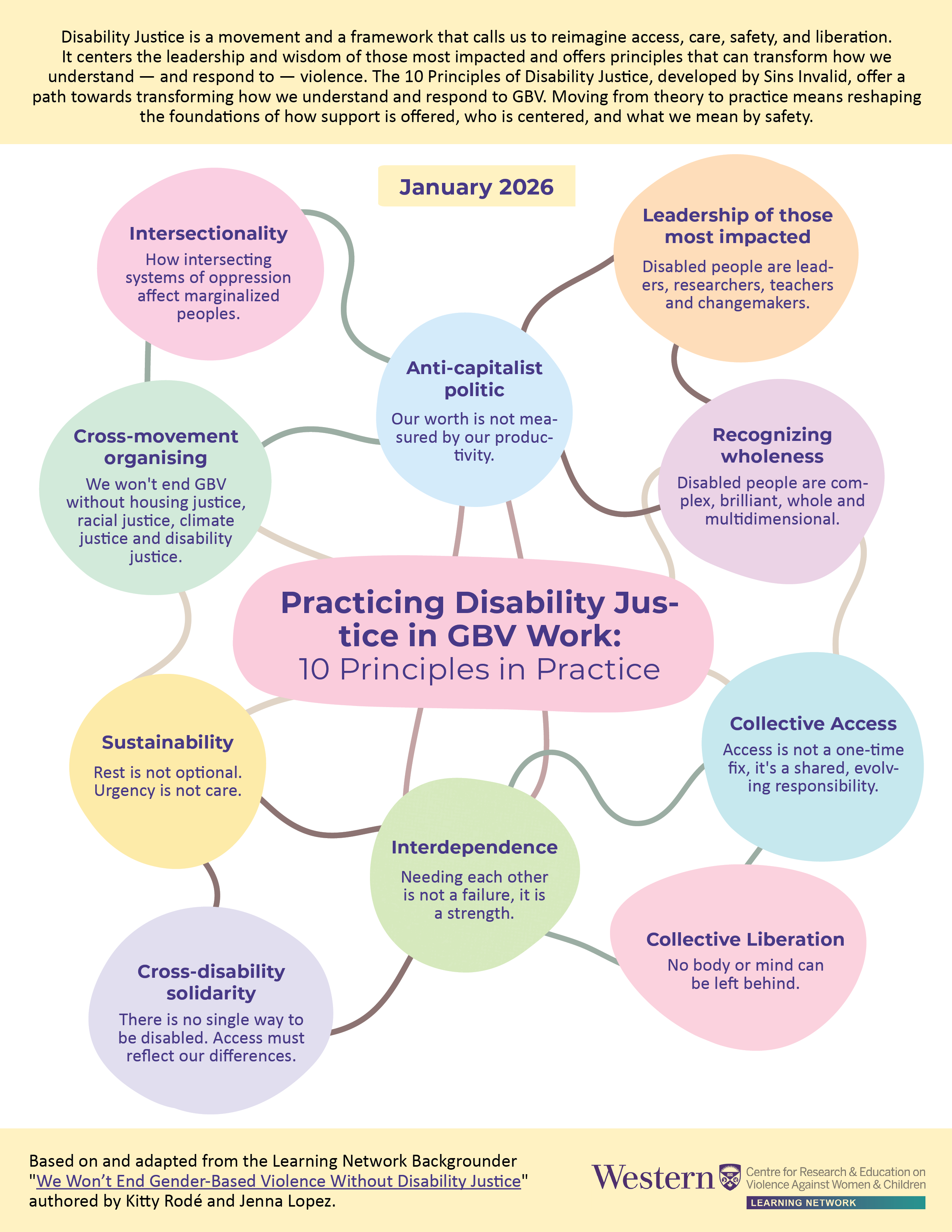
Disability Justice is a movement and a framework that calls us to reimagine access, care, safety, and liberation. It centers the leadership and wisdom of those most impacted and offers principles that can transform how we understand — and respond to — violence. The 10 Principles of Disability Justice, developed by Sins Invalid, offer a path towards transforming how we understand and respond to GBV. Moving from theory to practice means reshaping the foundations of how support is offered, who is centered, and what we mean by safety.
Practicing Disability Justice in GBV Work:10 Principles in Practice
- Intersectionality
How intersecting systems of oppression affect marginalized peoples - Collective Liberation
No body or mind can be left behind. - Collective Access
Access is not a one-time fix, it's a shared, evolving responsibility. - Cross-movement organising
We won't end GBV without housing justice, racial justice, climate justice and disability justice. - Cross-disability solidarity
There is no single way to be disabled. Access must reflect our differences. - Recognizing wholeness
Disabled people are complex, brilliant, whole and multidimensional. - Leadership of those most impacted
Disabled people are leaders, researchers, teachers and changemakers. - Anti-capitalist politic
Our worth is not measured by our productivity. - Interdependence
Needing each other is not a failure, it is a strength. - Sustainability
Rest is not optional. Urgency is not care.
La justice pour les personnes avec limitation constitue à la fois un mouvement et un cadre qui nous invitent à repenser l’accessibilité, les soins, la sécurité et la libération. Axée sur le leadership et les connaissances des personnes les plus touchées, elle présente des principes qui transforment notre compréhension de la violence ainsi que notre façon d’y réagir. Les 10 principes de la justice pour les personnes avec handicap, élaborés par Sins Invalid, montrent le chemin à suivre pour comprendre la violence basée sur le genre et parvenir à l’éliminer. Pour passer de la théorie à la pratique, il faut repenser la manière même dont le soutien est offert, centrer les personnes concernées et réimaginer ce que nous entendons par « sécurité ».
Fondé sur le document d’information du LN intitulé « L’élimination de la violence basée sur le genre est impensable sans justice pour les personnes avec limitation », de Kitty Rodé et Jenna Lopez, et adapté de celui-ci.
Janvier 2025
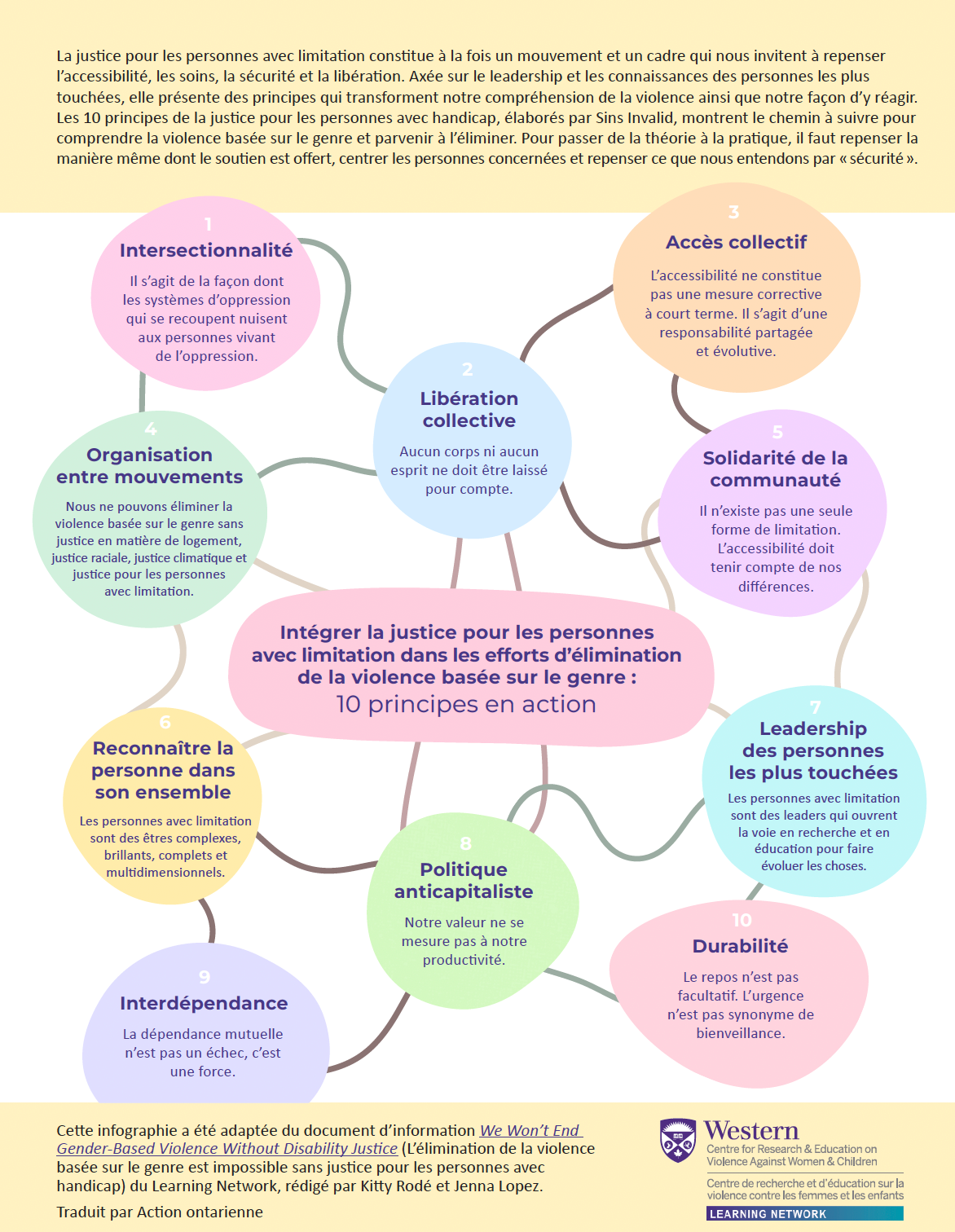
La justice pour les personnes avec limitation constitue à la fois un mouvement et un cadre qui nous invitent à repenser l’accessibilité, les soins, la sécurité et la libération. Axée sur le leadership et les connaissances des personnes les plus touchées, elle présente des principes qui transforment notre compréhension de la violence ainsi que notre façon d’y réagir. Les 10 principes de la justice pour les personnes avec handicap, élaborés par Sins Invalid, montrent le chemin à suivre pour comprendre la violence basée sur le genre et parvenir à l’éliminer. Pour passer de la théorie à la pratique, il faut repenser la manière même dont le soutien est offert, centrer les personnes concernées et réimaginer ce que nous entendons par « sécurité ».
- Intersectionnalité
Il s’agit de la façon dont les systèmes d’oppression qui se recoupent nuisent aux personnes vivant de l’oppression. - Libération collective
Aucun corps ni aucun esprit ne doit être laissé pour compte. - Accès collectif
L’accessibilité ne constitue pas une mesure corrective à court terme. Il s’agit d’une responsabilité partagée et évolutive. - Organisation entre mouvements
Nous ne pouvons éliminer la violence basée sur le genre sans justice en matière de logement, justice raciale, justice climatique et justice pour les personnes avec limitation. - Solidarité de la communauté
Il n’existe pas une seule forme de limitation. L’accessibilité doit tenir compte de nos différences. - Reconnaître la personne dans son ensemble
Les personnes avec limitation sont des êtres complexes, brillants, complets et multidimensionnels. - Leadership des personnes les plus touchées
Les personnes avec limitation sont des leaders qui ouvrent la voie en recherche et en éducation pour faire évoluer les choses. - Politique anticapitaliste
Notre valeur ne se mesure pas à notre productivité. - Interdépendance
La dépendance mutuelle n’est pas un échec, c’est une force. - Durabilité
Le repos n’est pas facultatif. L’urgence n’est pas synonyme de bienveillance.
All our resources are open-access and can be shared (e.g., linked, downloaded and sent) or cited with credit. If you would like to adapt and/or edit, translate, or embed/upload our content on your website/training materials (e.g., Webinar video), please email us at gbvln@uwo.ca so that we can work together to do so.