
Ash Lowenthal
-
English
-
Français
-
ASL
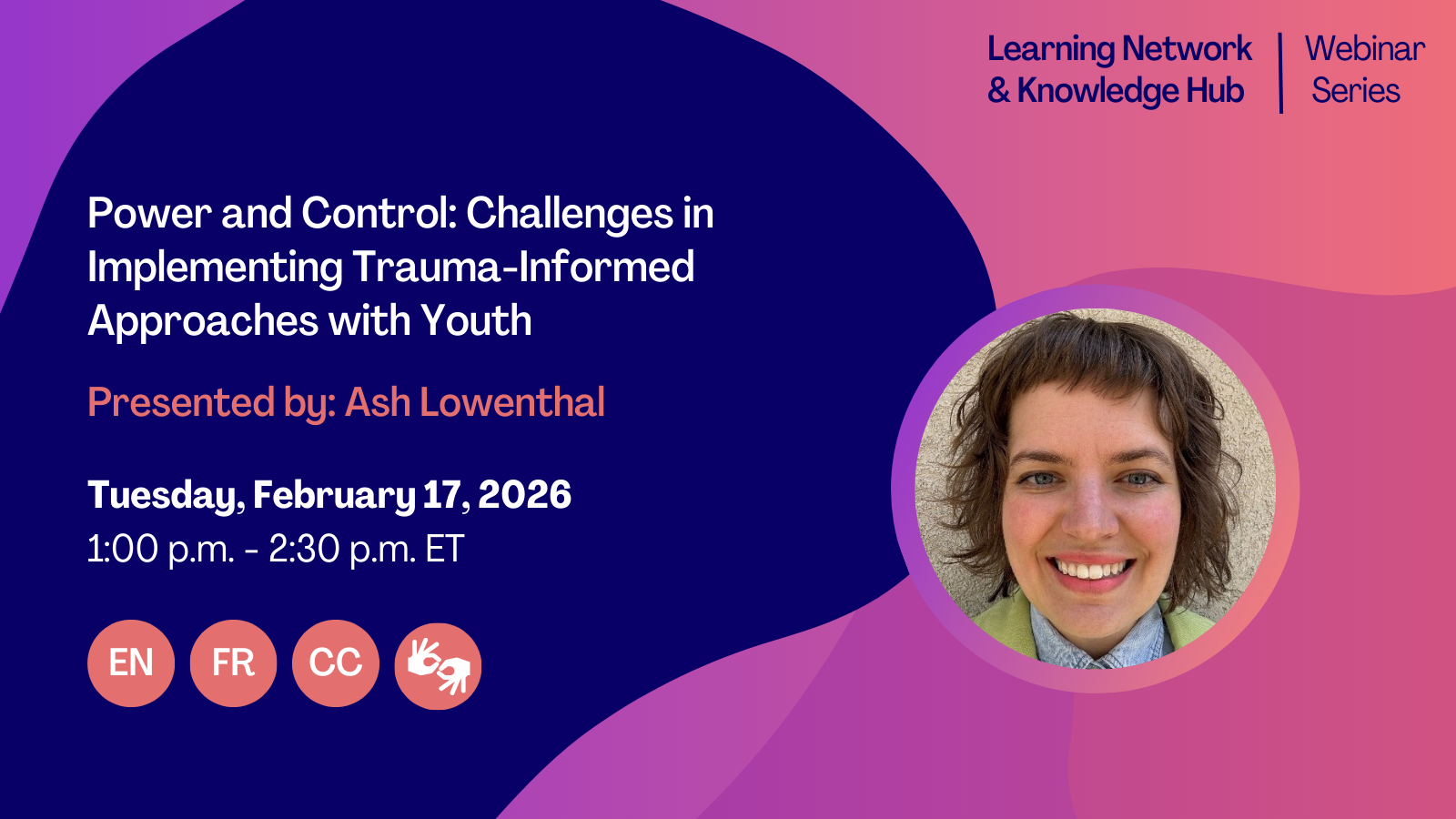
Power and Control: Challenges in Implementing Trauma-Informed Approaches with Youth
This Webinar will be presented and recorded on February 17, 2026
This presentation explores the practical and systemic challenges involved in implementing trauma-informed approaches (TIAs) in youth settings and draws on findings from doctoral research conducted in residential care settings with youth. While practitioners implementing TIAs seek to fundamentally transform the ways in which we support youth, their efforts are hindered by the persistence of compliance-focused practices, coercive responses in times of crisis, and ongoing difficulties in addressing power dynamics.
The presentation will also discuss adultism, a concept rarely discussed in our work, which is a form of structural oppression that shapes the practices, frameworks, and expectations relating to youth.
We will also explore why power dynamics are central to TIAs, how tensions between behavioural and relational approaches manifest in practice, and what barriers and drivers influence the sustainability of implementation. Additionally, the presentation will include promising strategies that support meaningful, ongoing organizational change.
Learning Objectives
By the end of this presentation, participants will be able to:
- Understand why power dynamics are central to TIA s
- Ex amine the tensions between behavio u rist models and relational approaches , and understand how adultism contributes to the normalization of compliance-based approaches
- Identify key barriers and drivers for the sustainable implementation of TIA
- Discover promising strategies to support organizational change
Speaker

Ash Lowenthal is completing her doctorate in social work at McGill University, where she is studying the implementation of trauma-informed approaches (TIAs) in youth settings, as well as the power dynamics between adults and youth. Her doctoral work highlights tensions between compliance-focused behavioral approaches and relational practices in rehabilitation units. She is developing expertise in the field of trauma grounded in structural, critical, and decolonial perspectives, and views the implementation of TIAs as a process of organizational and social transformation.
Ash is a research coordinator with the Canadian Consortium on Trauma for Children and Adolescents, where she contributes to national training and knowledge mobilization initiatives, and collaborates with various partners to strengthen trauma- and violence-informed practices.
With over fifteen years of involvement in youth, community, and social settings, Ash has supported numerous children, youth, and families. As the mother of a three-year-old boy — her greatest teacher — she views their relationship as a living space to explore power sharing with children.
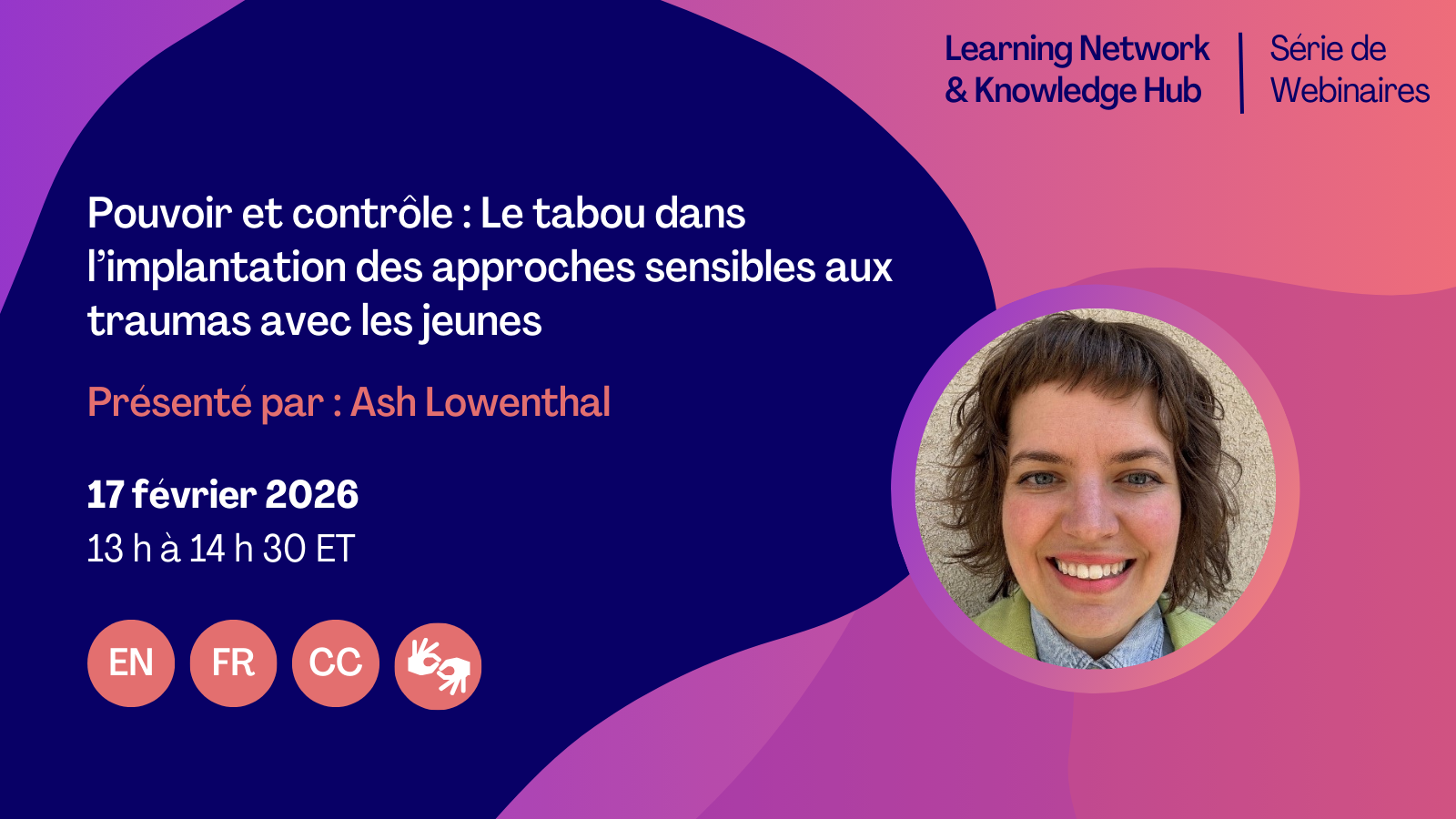
Pouvoir et contrôle : Le tabou dans l’implantation des approches sensibles aux traumas avec les jeunes
Ce webinaire sera présenté et enregistré le 17 février 2026.
Cette présentation examine les défis concrets liés à l’implantation des approches sensibles aux traumas (AST) dans les milieux jeunesse, à partir des résultats d’une recherche doctorale menée en contexte résidentiel. Bien que les AST visent à transformer en profondeur nos façons d’accompagner les jeunes, leur mise en œuvre se heurte à la persistance de pratiques axées sur la conformité, à des réflexes coercitifs en situation de crise et à une difficulté durable à aborder les dynamiques de pouvoir.
J’aborderai aussi l’adultisme, un concept encore trop peu discuté dans nos milieux : une forme d’oppression structurelle qui façonne nos pratiques, nos attentes et les cadres dans lesquels les jeunes évoluent.
Nous verrons pourquoi les dynamiques de pouvoir sont centrales aux AST, comment les tensions entre approches béhavioristes et relationnelles apparaissent sur le terrain, quels obstacles et leviers influencent l’implantation durable, et quelles stratégies prometteuses peuvent soutenir un changement organisationnel réel et soutenu.
Objectifs d'apprentissage
À la fin de cette présentation, les participants seront en mesure de :
- Comprendre pourquoi les dynamiques de pouvoir sont centrales aux AST
- Explorer les tensions entre modèles béhavioristes et approches relationnelle et comprendre comment l’adultisme crée un contexte qui normalise les approches axées sur la conformité
- Identifier les obstacles et leviers clés à l’implantation durable des AST
- Découvrir des stratégies prometteuses pour soutenir le changement organisationnel
Biographie du présentateur
Ash Lowenthal achève son doctorat en travail social à l’Université McGill, où elle étudie l’implantation des approches sensibles aux traumas (AST) en milieux jeunesse et les dynamiques de pouvoir entre adultes et jeunes. Sa thèse met en lumière les tensions entre approches béhavioristes axées sur la conformité et pratiques relationnelles dans les unités de réadaptation. Elle développe une expertise du trauma ancrée dans une perspective structurelle, critique et décoloniale, et conçoit l’implantation des AST comme un processus de transformation organisationnelle et sociale.
Ash est coordonnatrice de recherche au Consortium canadien sur le trauma chez les enfants et les adolescents, où elle contribue à des initiatives nationales de formation et de mobilisation des connaissances, et collabore avec divers partenaires pour renforcer les pratiques sensibles aux traumas et à la violence.
Avec plus de quinze ans d’implication dans les milieux jeunesse, communautaires et sociaux, elle a soutenu de nombreux enfants, jeunes et familles. Maman d’un petit garçon de trois ans — son plus grand professeur — elle voit leur relation comme un terrain vivant d’exploration du partage de pouvoir avec les enfants.
Power and Control: Challenges in Implementing Trauma-Informed Approaches with Youth
This Webinar will be presented and recorded on February 17, 2026
This presentation explores the practical and systemic challenges involved in implementing trauma-informed approaches (TIAs) in youth settings and draws on findings from doctoral research conducted in residential care settings with youth. While practitioners implementing TIAs seek to fundamentally transform the ways in which we support youth, their efforts are hindered by the persistence of compliance-focused practices, coercive responses in times of crisis, and ongoing difficulties in addressing power dynamics.
The presentation will also discuss adultism, a concept rarely discussed in our work, which is a form of structural oppression that shapes the practices, frameworks, and expectations relating to youth.
We will also explore why power dynamics are central to TIAs, how tensions between behavioural and relational approaches manifest in practice, and what barriers and drivers influence the sustainability of implementation. Additionally, the presentation will include promising strategies that support meaningful, ongoing organizational change.
By the end of this presentation, participants will be able to:
- Understand why power dynamics are central to TIA s
- Ex amine the tensions between behavio u rist models and relational approaches , and understand how adultism contributes to the normalization of compliance-based approaches
- Identify key barriers and drivers for the sustainable implementation of TIA s
- Discover promising strategies to support organizational change
Speaker
Ash Lowenthal is completing her doctorate in social work at McGill University, where she is studying the implementation of trauma-informed approaches (TIAs) in youth settings, as well as the power dynamics between adults and youth. Her doctoral work highlights tensions between compliance-focused behavioral approaches and relational practices in rehabilitation units. She is developing expertise in the field of trauma grounded in structural, critical, and decolonial perspectives, and views the implementation of TIAs as a process of organizational and social transformation.
Ash is a research coordinator with the Canadian Consortium on Trauma for Children and Adolescents, where she contributes to national training and knowledge mobilization initiatives, and collaborates with various partners to strengthen trauma- and violence-informed practices.
With over fifteen years of involvement in youth, community, and social settings, Ash has supported numerous children, youth, and families. As the mother of a three-year-old boy — her greatest teacher — she views their relationship as a living space to explore power sharing with children.
All our resources are open-access and can be shared (e.g., linked, downloaded and sent) or cited with credit. If you would like to adapt and/or edit, translate, or embed/upload our content on your website/training materials (e.g., Webinar video), please email us at gbvln@uwo.ca so that we can work together to do so.